Third in a two-horse race
Gorton and Denton by-election

The architects of Labour’s third place in the previously safe seat of Gorton and Denton by-election are the right wing of the Labour Party - of course in Downing Street but also through their political groupings such as Labour To Win, Labour First, and Progress.
It was the politics of Labour’s right that led to this point - their economic and social policy choices, their record on Gaza, their machine politics against both left and soft left, and their insistence on a narrow electoral definition of who the party needs to base itself on.
What happened? The Green Party came from a distant position with to win 40.7% of the vote, with Reform second on 28.7% and Labour down to third, way behind the Greens, on 25.4%.
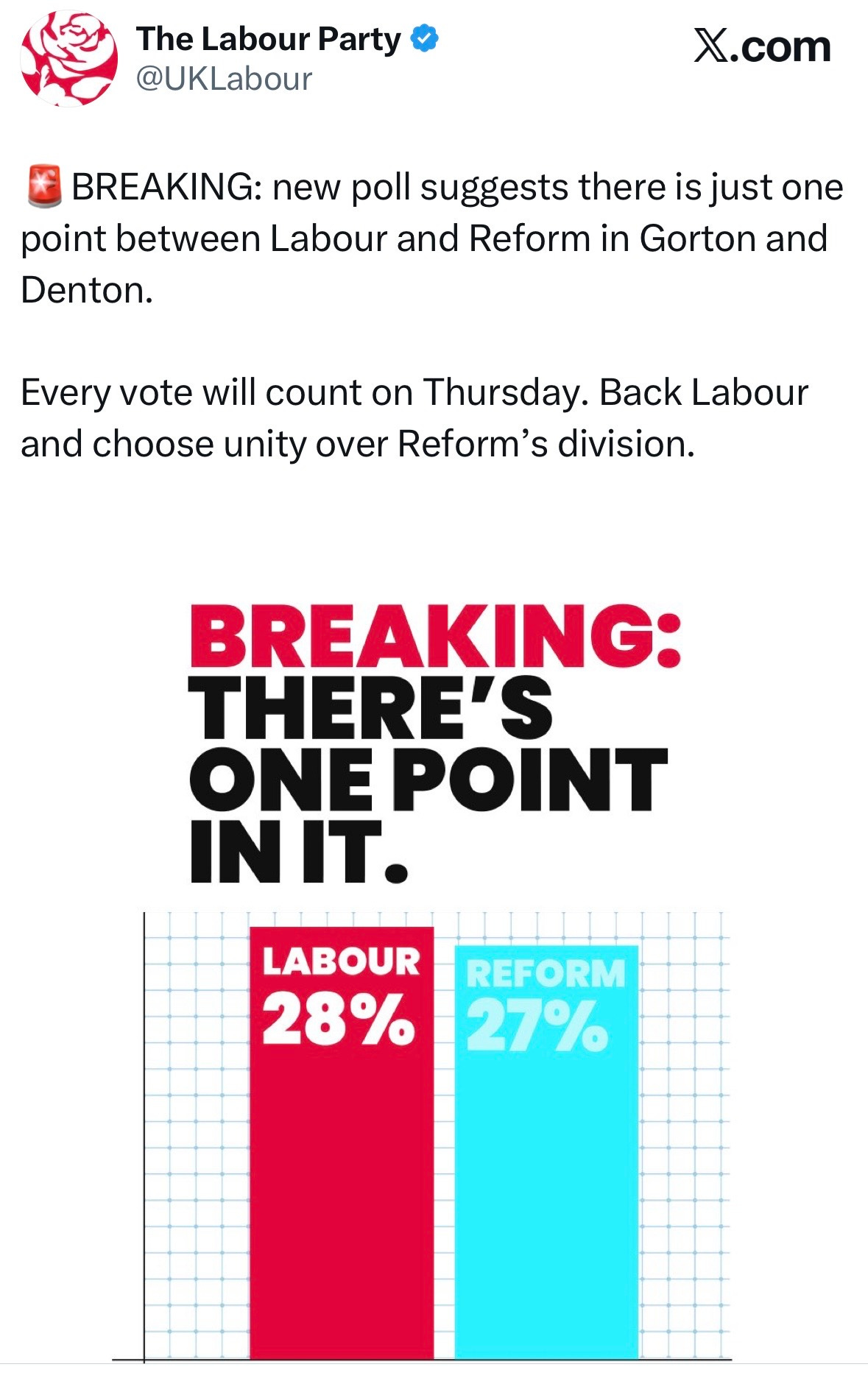
Yet throughout the by-election campaign Labour campaign insisted that it was a two-horse race between Labour and Reform, and only Labour could stop Farage’s right wing party. That line was combined with messaging towards the Greens that had some echoes of how Labour used to try to deal with the rise of the LibDems during Tony Blair’s leadership. Labour’s general secretary was quoted as saying that ‘the Green Party are clearly high on the Class-A drugs they want to legalise if they think they are in this race because we know they are not.’ Either Labour knew this was not true or its data was worthless. The party’s tactics descended into outright lying, producing a bar chart showing a tight race between Labour and Reform by omitting the full chart that placed the Greens at the same level (indeed the fuller result of the same Opinium polling showed the Greens ahead), and invented a totally fake tactical voting organisation ‘Tactical Choice’ that purported to recommend a Labour vote to stop Reform. All of this was an effort to bend reality to fit Labour’s script that it was fight between Labour and Reform. As it transpired, Labour came third in that two horse race.
The Labour Party’s appeals to vote Labour to stop Reform fell on deaf ears because there is widespread anger at Labour itself - and Keir Starmer in particular.
At the outset of the by-election Labour’s soft left sought to put forward an alternative, proposing Greater Manchester Mayor Andy Burnham go forward as a candidate for selection as the candidate for the by-election. Only one member of the NEC officers group voted in favour of allowing this - the deputy leader Lucy Powell. The rest of the NEC officers took the lead from Keir Starmer and blocked Burnham. Right wing members of the PLP and activists in the party welcomed the NEC’s fix and indeed crowed about it. Polling organisations showed through focus group work that the stitch-up of Burnham was damaging to perceptions of Labour amongst voters in the seat.
The conundrum for the soft left is that having argued for a different course with Burnham, it then was forced into accepting a role in trying to win Gorton and Denton under the very right wing leadership that had blocked it.
As we have discussed before, the cause of Labour’s terrible standing is the policies of the right wing of the Labour Party, which leads the politics of the party in government and dominates its apparatus, particularly through the right wing Labour To Win coalition. Labour’s big majority in the 2024 general election masked a relatively low popular vote. Labour then took an axe to that already low support through a series of unpopular decisions, beginning with the attack on the pensioners’ winter fuel allowance. Winter fuel payments are still repeated back on the doorstep and in focus groups as proof of the party’s rupture with the public.
Labour’s unpopular decisions flow primarily from its approach to the economy, which contains neither the necessary levels of public investment, nor solutions to the cost of living crisis. Living standards for millions of people are still drastically squeezed. At the same time the Labour government caused trust and support to evaporate amongst many traditional supporters through its record on Gaza, replaced with lasting fury.
Yet when a concerns about Labour’s approach are raised, the right wing of the Labour Party maintains that it is necessary to stay the course. In January, Labour MP Luke Akehurst on Twitter/X used one poll to argue that ‘there is not much support for other progressive parties’, dismissing arguments to take voters on Labour’s left flank as being a ‘comfort zone/soft left’ road, and that Labour’s priorities meant focusing on winning votes back from Reform. Gorton and Denton underlines how mistaken it has been to dismiss the potential impact of the Greens. Labour’s folly has been to fail to seek to build an alliance of voters more broadly than simply a cohort of ‘hero voters’, allowing its base to shrink, with flanks opening both to the left and the right.
Some argued after the Caerphilly by-election defeat that it was not all bad news for Labour’s chances at the next general election because it showed that Reform can be beaten with tactical voting. On that occasion, so the argument went, the beneficiaries were Plaid Cymru, but in other circumstances Labour could prove to be the recipient of anti-Reform tactical voting. Gorton and Denton demonstrates the utter complacency of that analysis, reflecting a failure to come to terms with the levels of anger that exists towards Labour.
After Gorton and Denton, it is necessary to return to the point: only by ending the dominance of the political project that produced this crisis is it possible to move beyond it.