The Labour right’s strategy is devastating the party
The Labour right's strategy has failed

The results of the elections on 7 May are not all in but they are devastating for the Labour Party. In Wales, Scotland and in English local government Labour is losing badly.
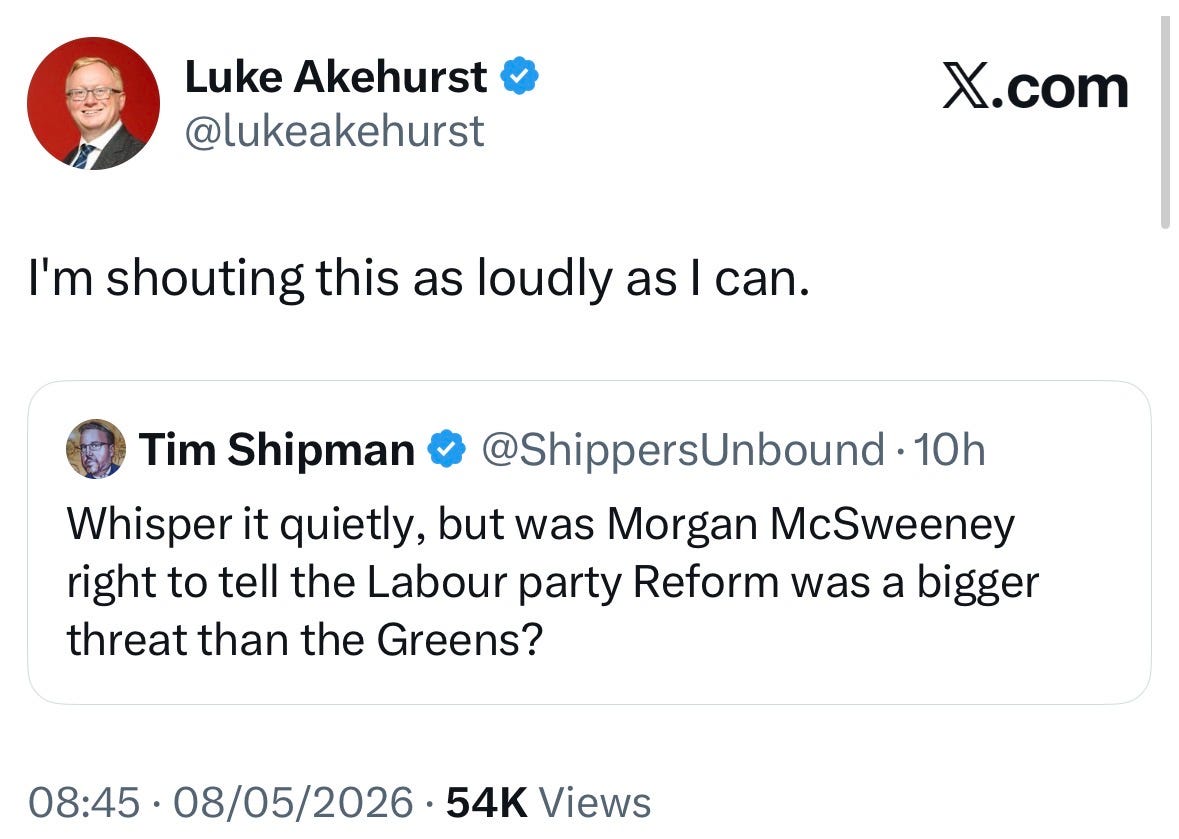
One initial point should be addressed immediately. Labour losses to Reform could be used to shape a disproportionate argument about the lessons of Labour’s political approach. On Twitter/X, the Spectator’s political editor Tim Shipman wrote ‘Whisper it quietly, but was [former Starmer adviser] Morgan McSweeney right to tell the Labour party Reform was a bigger threat than the Greens?’ Tim Shipman’s point was enthusiastically taken up by Labour MP Luke Akehurst: ‘I’m shouting this as loudly as I can.’
A problem with counterposing potential Labour voters in this way is that it leads not to building a meaningful electoral alliance across the whole of the working class in its breadth, and between middle and low income earners, the north and south and so on. Instead it takes one section of the electorate for granted: voters are expected to simply stick with Labour because they have nowhere else to go. As a strategy it is a comfort zone for the Labour right, and it is not working: Labour is losing in Sunderland and Hackney. It is losing Wales and going backwards in Scotland.
In reality, shedding votes to the Greens by creating a space to Labour’s left makes it harder to stop Reform where Reform are the threat.
Adam Bienkov has written this up today for Byline Times:
Reform’s gains in these areas will be taken as a reason for doubling down on their strategy of talking up culturally conservative issues like immigration. When all you have is a hammer, then everything looks like a nail.
However, as the elections guru John Curtice set out this morning, the reality is quite different.
As he told the BBC: “A sharp fall in Labour’s performance is accompanied more often by an above average Green performance than it is by a strong Reform performance…”
“Labour may often lose seats to Reform because it is losing votes to the Greens, while the Conservatives are losing votes to Reform. The net effect can be that Labour end up losing a seat to Reform”.
In other words Labour may be losing seats to Reform, but that is mostly because they are losing actual votes to the Greens. In the party’s former Northern heartlands this fact is helping Reform, yet in other parts of the country it is helping the Greens.
In this clip, posted by Ben Folley, Curtice expands on his point, in which he emphasises that Labour is losing more support to the Greens than to Labour, and that ‘a good Green performance is more damaging for Labour than a good Reform performance.’
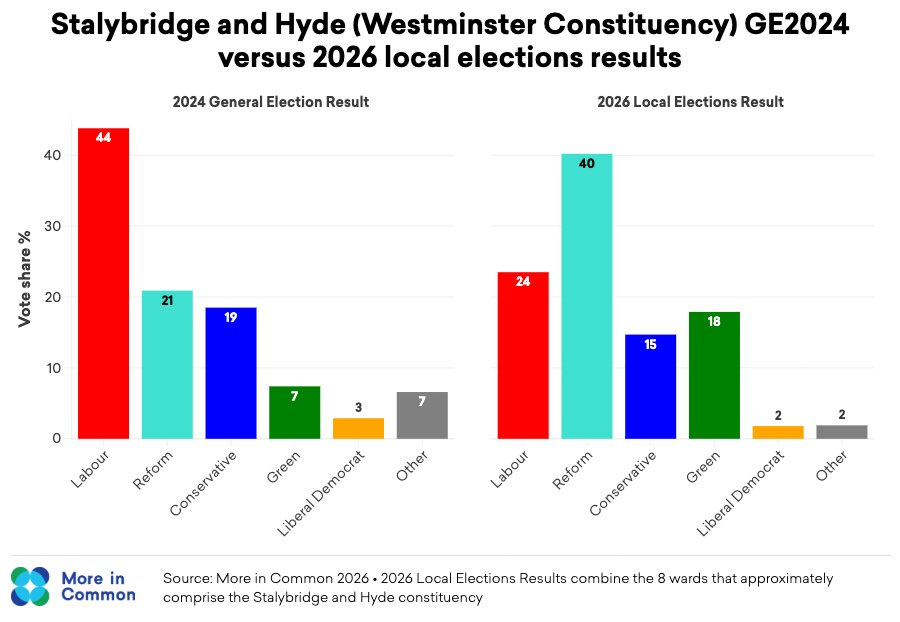
We can see this trend being played out in many of the results. As Luke Tryl of More In Common noted, in the eight wards that correspond to the seat of chief whip Jonathan Reynolds there was a 20pt swing from Labour to Reform, with Greens up double digits too: ‘Left-Right Pincer movement in full swing.’ In this week’s election, Labour was on 24%, Reform on 40% and the Greens on 18%, up from 7% since the general election. If the Labour Party had not created a space on its flank that the Greens had filled it would have been harder to for Reform to win.
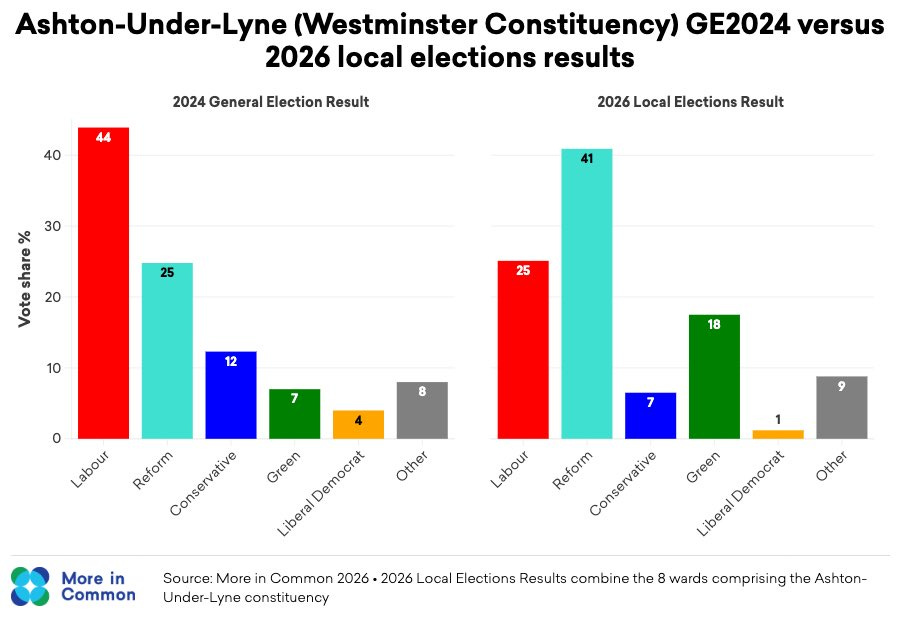
Again, in the eight wards corresponding to Angela Rayner’s constituency, More In Common shows Labour on 25%, Reform on 41% and the Greens on 18%, once more up from 7%. Labour could not afford to create this space, but did so anyway. That was the strategy of Labour’s right.
So the alienation of swathes of voters who chose to go Green makes it harder to deal with the threat to Labour’s right.
Some respond to the outcome of the elections with the formula ‘vote Green, get Reform.’ But that no longer works when the position has broken down to the degree we are now seeing: indeed in many wards where Labour has been pushed into third, Greens could easily flip that framing back onto Labour.
It would be better to understand and address the political error that has created a flank to Labour’s left, which involved failing to build a big enough electoral bloc that could stop politics being dragged rightwards.