Exclusive - Labour facing historic council losses in the North East
Labour projected to lose Newcastle, Sunderland, Gateshead and South Tyneside

Labour is set for historic losses in Tyneside and Wearside at this May’s local elections, according to new public opinion modelling which has already shown devastating prospects for Labour in London and Birmingham.
The top line for the elections across Tyneside and Wearside shows Labour losing control of all four councils up for all-out elections in May: Newcastle City Council, Gateshead, Sunderland and South Tyneside would all be taken by Reform. In the whole of Tyne & Wear Labour would then hold only North Tyneside, where one third of seats are up for grabs and which would also see Reform make big advances.
Last week the Guardian reported local elections modelling by the audience insight platform Bombe, forecasting that Labour, which holds 21 boroughs in London, could lose authorities such as Hackney and Lambeth to the Greens. Labour would lose more than half its council seats – many to the Greens – in Camden, where Keir Starmer is an MP. The Guardian’s political editor Pippa Crerar quoted Tony Travers of the London School of Economics as saying Labour was course for a ‘political earthquake’ if Bombe’s modelling reflected the actual result this May.
I have now had the opportunity to look at the company’s modelling for the elections and it makes for similarly damaging news for Labour, this time in the authorities in the North East conurbation of Tyne & Wear.
Translated into seats, Reform is projected to win 222 councillors across the four councils, a huge leap from its total of just one at present. Labour would be left with 51 Councillors. The Liberal Democrats would have 30 councillors, down 22. The Greens may well effectively stand still, making gains in some seats but possibly losing in others, bringing their total to 12 overall – down one. The Conservatives would have 11 councillors, up three.
If something approaching that scenario happens in Wearside and Tyneside it would be a disaster for Labour, which has traditionally dominated the politics of the area. Labour currently holds not only all the local authorities in Tyne and Wear, but every single one of the parliamentary seats too.
Labour’s difficulties in the forthcoming elections show that it is squeezed by the rise of Reform on the one hand, and the growth of support for the Greens on the other, which places the Green Party into contention in a number of locations where previously Labour was untroubled on its left-progressive flank.
A change in the leaderships of Gateshead, Newcastle, Sunderland and South Tyneside would cause a major shift in the composition of the North East Combined Authority, reducing Labour’s six members of the authority down to one, and setting up a very different dynamic for the authority’s elected mayor, Labour’s Kim McGuinness.
Methodology
The Bombe methodology differs from existing MRP models which are based on large polling samples. The gradient-boosted regression modelling (GBRM) uses actual election results along with polling data from Deltapoll. This results based prediction model is based on the behaviour of voter personas in wards between 2022-2026. Using gradient boosted regression prediction it has built dozens of models that overlay voting over the behaviour of the personas in the electoral wards over that time period. This allows it to produce accurate predictions that are based on real-world behaviour over a four year period, as opposed to polling samples from a specific point in time when a poll is done. The model has been validated against election results, and on the basis of recent by-elections has had 85% accuracy. That means that it does not pretend to have absolutely every result nailed down weeks and months in advance, but it also offers a new way of understanding voter trends and behaviour.
As it stands, the model looks at party support levels not actual candidates - once the list is published this will be factored into the model. When that is done it may have an important role in clarifying some of the contests, such as in South Tyneside (see below).
Earthquake in the North East
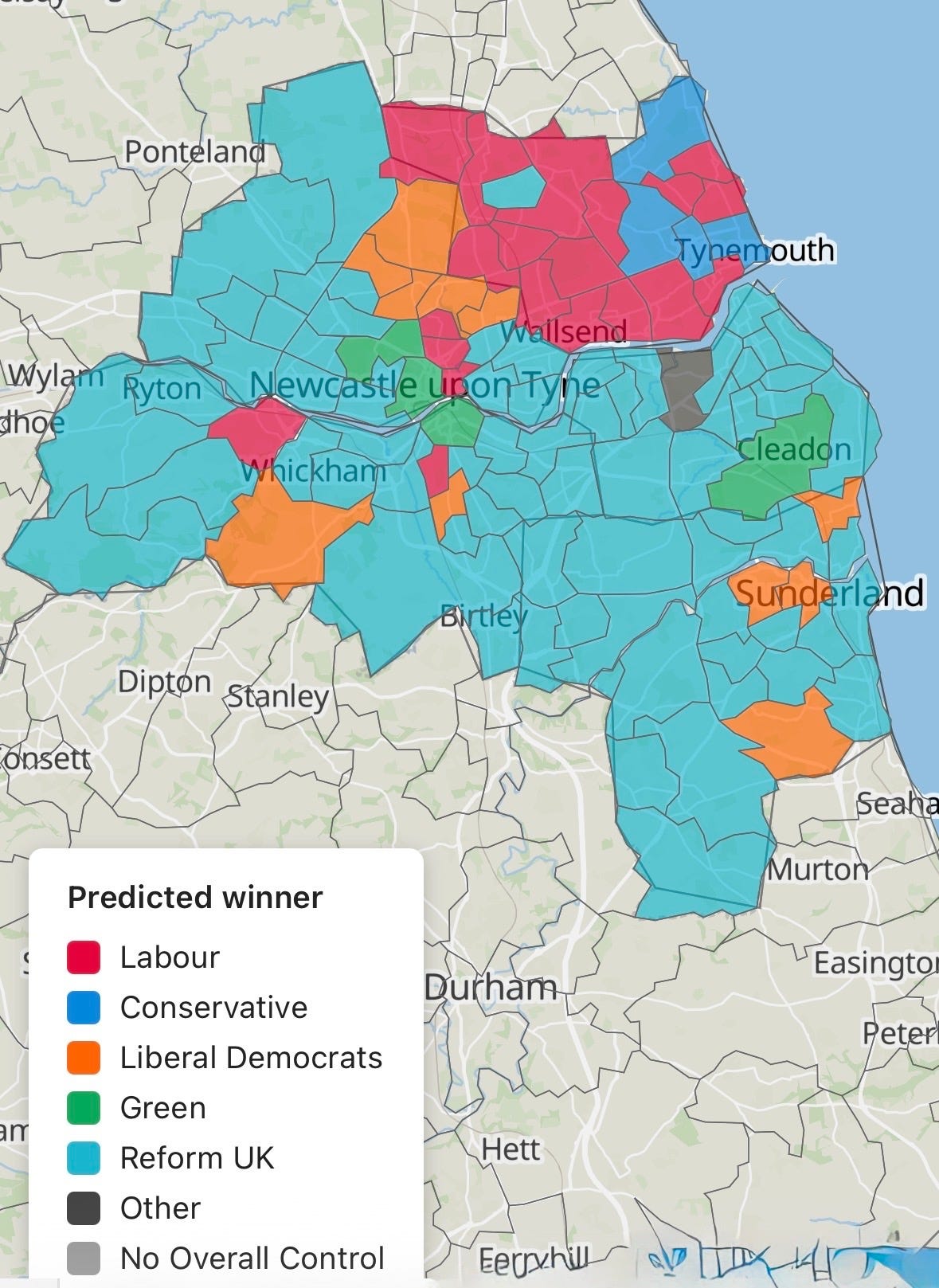
In Newcastle, Reform is projected to take 45 council seats, whilst Labour’s representation would fall to 10, down 24. The Liberal Democrats would lose 8 councillors for a new total of 14. Greens would go up 2 to 6. (There would also be 1 independent).
Labour would lose West Fenham where its leader Karen Kilgour is a local councillor. It is an indication of how far the ground has shifted that Karen Kilgour’s ward - currently held by two Liberal Democrats as well as Labour - is now projected to be taken by Reform, on just over 27%, with Labour and the Greens deadlocked on 22%.
On these projections, Labour looks set to lose Wingrove ward to the Green Party. The Greens are also projected win at least two council seats in a narrower contest in Monument, where former North of Tyne Mayor Jamie Driscoll is a Green candidate.
As the Gorton and Denton by-election showed, there is no certainty that voters will choose to vote Labour to stop Reform, when in many cases they also wish to vote to express their anger with Labour. It is unclear whether an anti-Reform vote will coalesce, but it is certainly the case that there are now wards where the Greens are either the main rival to Reform, or Labour are in fight to secure that position. In Benwell & Scotswood for example Reform are currently at 32.5% with the Greens on 25% and Labour on 21.1%. At the 2024 election Labour won Kenton with 65.3% of the vote: on the present projection, Reform is on 25.8%, with the Greens on 25.3% and Labour at 23.2%. In Elswick however - currently split and with both Green and Labour representation - Reform is projected to be ahead on 31.6%, with Labour and the Greens on 25.1% and 23.3% respectively.
The fractured political situation is both an opportunity and a challenge for the Greens: two currently split wards – Ouseburn and South Jesmond – are shown falling to Labour. It should be said that the findings are subject to the earlier caveat: once the list of candidates is published this will need to be factored into the model. As a result some polling outcomes may change.
Across the Tyne in Gateshead, the rise of Reform means Labour is shown holding onto Blaydon and taking a seat in Saltwell but losing all other wards. In a very striking development the Greens are now in second place to Reform in a host of wards on these projections, including in Crawcrook & Greenside, Chopwell & Rowlands Gill, Dunston & Teams, Lobley Hill & Bensham, Deckham, and Felling. With Reform in first place, Winlaton and High Spen has just 0.3% difference between Labour and the Greens for second and third, and in High Fell Labour are second to Reform’s 33.8% on 22.2%, with the Greens just behind on 21%.
Most notably, on this projection the Greens would take all three seats in Bridges ward, on 28.1% to Labour’s 23.6%, with Reform third.
Liberal Democrats are shown to be losing one seat in Wickham South & Sunniside and one in Low Fell - and losing Wickham North and Dunston Hill & Wickham East entirely.
Under the model the final result would mean Reform would hold 51 seats in Gateshead, with Labour on 6, LibDems on 4, Greens on 3, and the Conservatives with 1.
Sunderland’s projections also show a dramatic Labour collapse, with Reform winning heavily but with a few examples of tighter Labour-Green contests that result in Reform coming through the middle - Houghton, Shiney Row, Silksworth and Ryhope - suggesting Greens may come second in around five wards. Liberal Democrats would hold or make gains in Doxford, Millfield, Pallion and Fulwell. Hendon has Reform on 30% but then LibDems, Green and Labour all effectively tied at 21%, 20.3%, 20.1%.
At the end of the May elections, unless something dramatic happens between now and the vote, it is quite possible on this modelling that Labour will not have a single seat on Sunderland council, with Reform taking 62 seats and the LibDems forming the opposition with 12 councillors.
Turning to South Tyneside, once again an extremely bad result is predicted for the Labour Party. Labour would lose control of the council and indeed every seat it currently holds, seeing Reform take 49 seats, the Greens holding Cleadon & East Boldon but down to three, and independents possibly on two.
It should be noted that recent elections have seen a number of strong results for independents. Therefore it should be necessary to look at South Tyneside’s projections once the full list of candidates is confirmed. Depending on that final list, in some of South Tyneside’s seats the Greens are a strong third and could prove to be competitive.
But the main story here is the projected collapse of Labour.
Finally, North Tyneside will provide a partial result as it is the only one of these authorities where the whole council is not up for election. This means that on the one hand it is the only authority to remain in Labour hands after May, but on the other hand it confirms the general position, since in the one third of council seats facing elections (twenty in total) Reform is projected to make major gains. After the election, Labour would be down 15 councillors to 35, Reform would be up 14 to 15 and the Tories would go up 2, now to hold 10.
Labour however would not be fully wiped out, and is projected to hold New York and Murton & Monkseaton. It also looks like it could put up a strong fight against Reform in Camperdown and Longbenton & Benton. In three wards along the Tyne – Howdon, Chirton & Percy Main and North Shields, the Greens are projected to run Reform very close, particularly in the latter two. In Chirton & Percy Main Reform are modelled at 25.3% to the Greens’ 23.5%, and in North Shields the race looks to be even closer – at 25.1% for Reform and 24.3% for the Greens.
Both Whitley Bay North and Cullercoats & Whitley Bay South have highly competitive races with the Tories projected to win both but with small margins between the parties: in the latter Labour and the Tories look to be effectively tied for first place at present, with Reform and the Greens not far behind them and almost tied too.
Conclusion
Mike Joslin, co-founder and CEO of Bombe, said: ‘Our ward-level model is built by benchmarking predictions against real-world election results. It has called the last 20 by-elections with 85% accuracy, and that gives us confidence when we see the same voter dynamics emerging across the North East.
‘In Tyne & Wear, we’re projecting a major realignment - with Reform moving into overall control in Newcastle upon Tyne, Gateshead, Sunderland and South Tyneside, while Labour holds North Tyneside, where only a third of seats are up this cycle.
‘Our model updates weekly as new data comes through, so we can track where the battleground is moving. But the big takeaway is that campaigning and individual votes will matter more than ever: across these five councils, many wards are tight, multi-party contests where a strong local ground game and credible candidate could be the difference between winning and losing.’
Polling and modelling are part of how parties and campaigners understand what is going on with public opinion, its trends and underpinnings. That knowledge then affect how parties campaign.
Nonetheless, the direction of travel is clear, and disastrous for the Labour Party, which now faces losing four of the five authorities in Tyne & Wear, alongside big local government losses in other parts of the country.